

1/2
Manual

2/2
Manual
Summary
The Formanta Manual is a polyphonic organ built during the Cold War by the Urals Vector Company, in Kachkanar, a city in the Sverdlovsk Oblast in Russia. It features the basic elements of a simple four-octave organ, a versatile rhythm section and an internal speaker.
Derived from the earlier FAEMI-M, the Manual designed by Vladimir Lugovets and Olympiada Kuzmina and manufactured from 1977. The instrument uses a transistor-based divide-down architecture with twelve independent oscillators, one for each note of the chromatic scale. Its organ section offers four combinable registers (16', 8', 4' and 2'), tone controls, sustain and release, vibrato and tremolo. The built-in rhythm machine provides sixteen combinable patterns driving five percussion voices, with adjustable tempo.
The Formanta Manual is particularly recognizable by its unusual “boot”-like cabinet, designed so that it could be hooked onto the front of a piano. It was sold in a kit comprising the instrument, a speaker, optional legs, a transport case and many accessories. Although several aspects of its cultural reception remain unknown, it is clear that the instrument occupies a unique place in the history of electrophones due to its distinctive features and the context of its emergence.
Features & use
Although commonly referred as a synth on YouTube and elsewhere, the Formanta Manual is actually an organ, as evidenced by its user manual as well as its structure, functions, and full polyphony by octave division. It’s actually an improved version of the FAEMI-M from 1976 : they share the same potentiometers, buttons and, like the Formanta Topaz electric accordion, the exact same circuity.
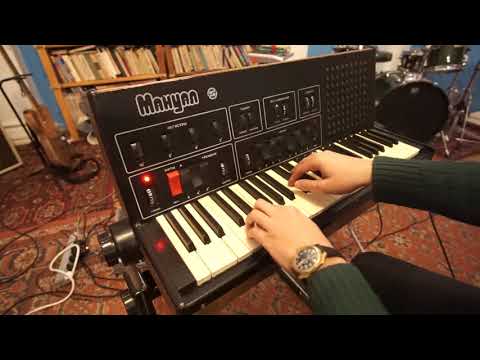
The Formanta Manual is divided into two internal sections : one for the organ and one rhythm section for the drum machine. The organ is based on a transistor and divide-down architecture. It features four combinable registers (16', 8', 4', 2’) with high and low frequencies level adjustment, sustain and release controls, a vibrato with rate and depth controls and individual tremolos switches for the four-foot and two-foot registers with a common rate control. A reed-switch ("herkon") keying is used across the four-octave keyboard.
The drum machine, for its part, is a 16-patterns rhythm box driving five percussion voices : kick drum, snare, low tom, and closed hi-hats for the cymbal and claves. The sixteen one- or two-bar rhythms, ranging from 'waltz’ to 'rock', are divided into two banks (A or B). The patterns of each bank can be combined at will to create interesting complex patterns. Only the tempo can be adjusted, from around 60 to 200 BPM.
Each section has its own volume control. A main volume knob sets the general output volume that is fed into the internal speaker or via the 5-Pin Din output. The Formanta Manual also features a quite uncommon 5-Pin Din CV input for a (main) volume pedal and a 5-Pin Din audio input.
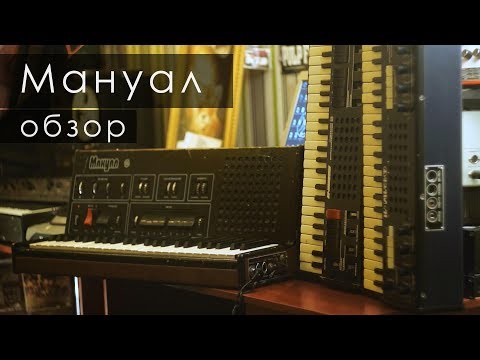
One of the most distinctive and unique features of this instrument is its ‘boot’-like shape – apparently that is what it was known as internally – that makes the Manual fall back when put on a table. It actually allowed user to hook it to the front panel of a piano, as pictured below. A single player could then perform as a trio : piano, organ and rhythm section.

1/5
the Manual's front panel (left side)

2/5
the Manual's front panel (right side)

3/5
the Manual's input/output ports

4/5
an ad for the Formanta Manual, presenting it as a "complement to the piano" (year unknown)

5/5
the Manual's internal speaker
Application In Music
The cultural contexts in which the Formanta Manual was used after leaving the factory are unclear, as there are no known recordings featuring its sounds. Its design, functions, optional legs and unique ‘boot’-like shape to hang it on a piano suggest that it was intended for popular use, at home or at dance parties as it was generally the case throughout the world with electronic organs in the second half of the 20th century. This hypothesis is supported by a statement made by Vladimir Kuzmin, the engineer behind the famous Polivoks synthesiser and a former employee of the Urals Vector Company. In an interview with Soundonsound.com in July 2010, he stated that although 'Soviet musicians wanted to own synthesizers, [...] there was no musical industry in Russia, simply plants manufacturing [military and domestic] equipment'.
We should note that the Manual was sold for 600 Soviet rubles (SUB), as stated on the license plate on the bottom of the instrument. This was equivalent to roughly 3 to 5 months of salary for the average Soviet citizen which allows to think that instrument was maybe primarily found in the upper classes of the society and less accessible than we would think nowadays.
Finally, at that time, the Soviet government generally prohibited the import of Western electronics (including synthesizers) and mostly manufactured domestic equipment as part of a programme to increase the overall volume of goods produced for the people and maintain production rates across the country. This combination of factors provides a plausible explanation for the lack of known musical compositions from that era featuring the instrument.
Fortunately, the interest in vintage instruments, which has been growing across the globe since the 2010s, means we now regularly come across demos of the instrument on YouTube. We can only hope that one day we’ll hear its distinctive sound and rhythms featured in a music recording, from the present or past.

Genesis and Distribution
According to ruskeys.net, a reference on Soviet electronic musical instruments, the Formanta Manual was developed by the Urals Vector Company, based in Sverdlovsk (now Yekaterinburg). Founded in 1941, the state-owned company initially manufactured military electronics, including missile guidance and radar systems, before diversifying into consumer goods following Party directives intended to maintain production as demand for military equipment declined.
Urals Vector operated two factories whose histories are sometimes confused: the 1940s 'original' electroautomatic factory in Sverdlovsk and the early 1970s ‘new’ radio factory named 'Formanta' in Kachkanar, a city about 250km far to the north from Sverdlovsk. The Polivoks synthesizer and Rockton drum machine were initially developed and produced in Sverdlovsk, while all instruments developed under the Formanta brand were manufactured in Kachkanar. That’s how the Rockton and the FAEMI-M, once their production was transferred to Kachkanar, became the Formanta UDS and the Formanta FAEMI-1M. The Polivoks stand as the only exception : it kept its name without the 'Formanta' prefix despite also being later mass produced in Kachkanar.
The Formanta Manual was manufactured 1977 in the Kachkanar factory alongside the Formanta EMS-01 and diverse radio equipment. It was engineered by Vladimir Lugovets, director of the bureau that controlled the development of electronic instruments at the Vector company. In 1972 in Sverdlovsk, he had engineered the FAEMI-M, the first commercially successful Soviet electronic keyboard, awarded by the medal of VDNH USSR, the central exhibition of economic achievements of the country at the time. The Manual was his last project, and the first design of Olympiada Kuzmina, Vladimir Lugovets’ daughter and Vladimir Kuzmin’s wife. She later designed the famous Polivoks synthesizer, engineered by her husband, and many other instruments such as the EMI/Formanta Kvintet, the Arton IK-51 and Arton VS-34.
Reception and legacy
As previously mentioned, we do not know how well sales of the Formanta Manual went once it left the factory. We can only formulate hypotheses based on the data and testimonies at our disposal.
What we know is that the Manual was sold for 600 Soviet rubles (SUB), as stated on the license plate on the bottom of the instrument. Engraving the price on the product was a common and mandatory practice in the Soviet Union : it ensured fair commercial practices across the country. The price was also set by the government, as indicated by the reference to the nomenclature ‘n° 077-01-1982/41’ and the reference number of the article ‘2354R’, both of which are also engraved on the license plate. Again, the Manual’s price was equivalent to roughly 3 to 5 months of salary for the average Soviet citizen, which could explain its apparent rarity.
Vladimir Kuzmin’s words for Soundonsound.com also suggest that the instrument may not have been produced to meet an economic demand : it may have been a political one. He says : “Soviet musicians wanted to own synthesizers, but there was no musical industry in Russia, simply plants manufacturing equipment as part of a programme to increase the overall volume of goods produced for the people. […] You must understand that the socialist economic system was based on a simple principle: statisticians monitored how many families owned, for example, TV sets, and the Party would then decide to increase this number by, say, 20 percent in the next five‑year plan. Then, the Ministry of Planning would formulate plans for the manufacturing plants. But there were too many factories, so the planners had to look for additional products. This explains why Russia produced so many electronic musical instruments; they were products proposed by enthusiasts to keep the plants busy.”
This further opacifies the status and social place of the instrument at the time of its release. Any further information is therefore very welcome.

1/3
the Manual's serial plate

2/3
an ad for the Formanta Manual featuring its accompanying 24W speaker (ca. 1984)

3/3
a presentation text about the Formanta Manual
Technical details
We have already mentioned the divide-down polyphonic architecture of the organ engine, the general boot-like shape of the instrument and its quite uncommon 5-pin DIN connectors for both the audio and CV inputs and the audio output. We should also mention here that the Manual’s organ section does not feature a single central oscillator generator all the semitones. Instead, it contains 12 independent transistor-based oscillators per note. Each generator can be tuned thanks to the 12 tuning screws on top of the cabinet. This not only allows the instrument to be used in microtonal contexts : it also explains the Manual’s apparent sonic richness. Indeed, although they were probably calibrated at the factory, the timbres vary slightly from one oscillator to another – a phenomenon which, incidentally, becomes more pronounced as the instrument wears in. The Manual is therefore, although unintentionally, a polytimbral instrument.
This design choice meant a greater number of components were required to ensure the instrument functioned properly. These were housed both at the rear of the control panel and beneath the keyboard – an unusual and difficult-to-access location for maintenance. This is why the Manual is one of the few instruments whose rear and bottom panels can be flipped down, much like closing the pages of a book.
To this we can add that the Manual was sold in a quite complete kit. It included : two legs that could be attached and adjusted on the side of the instruments, two hooks to hang it to the front panel of a piano, a foot controller to control the overall volume’s instrument, 5-pin DIN audio cables, spares parts, a flight case and an external loudspeaker available in two versions, the smaller one having a capacity of 24 Watts.

1/5
the Manual's tuning trims

2/5
the Formanta Manual's tuning trims, view from inside the instrument

3/5
a Formanta Manual with its speaker

4/5
a Formanta Manual presented with an other rare loudspeaker

5/5
a view of the inside of the Formanta Manual
Further reading
Documentation on the Formanta Manual is scarce. The links at the bottom of the page are among the only examples available; the rest consist of amateur demos on YouTube or adverts on Russian resale sites such as Avito.
The two most comprehensive and interesting sources remain the instrument's presentation page on Ruskeys.net and this complete presentation video on the YouTube channel of Russian synthesiser expert and artist Alexander Kodola, also known as Audiofond (Аудиофонд). The comments section is full of valuable information, including contributions from Vladimir Kuzmin. Kodola also filmed his detailed repair of the instrument in another video.
Summary Table
-
synthesis methodsubtractive
-
number2
-
typeanalog
-
modesnon-resonant high pass non-resonant low pass
-
parametersCutoff
-
FX typesVibrato Tremolo
-
FX parametersAmount Frequency/Rate
-
performance interfaceKeyboard [48keys]
-
aftertouch sensitiveNo
-
(optional) pedalsVolume
-
performance parametersTempo Rhythm Select Rhythm Volume Master Volume Timbre Volume
-
midiN/A
-
power type220-240V AC
-
audio/cv input(s)1x 5 Pin Din (Audio In) 1x 5 Pin Din (CV In)
-
audio/cv output(s)1x Internal Speakers (Audio Out) 1x 5 Pin Din (Audio Out)
-
dimensions780x290x360
-
weight18 kg
-
accessoriesFoot controller External Loudspeaker Audio Cable Manual Flight case Stand Screws and washers
-
spare pieces1x PM-0.5 fuse 1x MN-6.3-0.3 pilot lamp
Resources
- Formanta Manual on Ruskeys.net
- a complete demo of the Formanta Manual on YouTube.com
- Formanta Manual on Rw6ase.narod.ru
- Formanta Factory on Synth.market
- a repair of the Formanta Manual on YouTube.com
- Urals Vector Company (aka Vector State Enterprise) on Wikipedia.org
- Polivoks (and infos on the Formanta factory) on Soundonsound.com
- A short history of soviet synthesizers (and precious comments from Vladimir Kuzmin) on Reverb.com
- a demo of a restored Formanta Manual on YouTube.com
- a plug-in featuring sounds of the Formanta Manual on Sound-dust.com
- a plug-in based on the Manual on Pianobook.co.uk
Most of the songs on this 2025 album apparently feature the sound of a FAEMI-M (1976), an instrument that predates the Formanta Manual (1977) and uses the exact same circuitry to generate its sounds. This gives us an opportunity to consider the sounds of the instrument in a contemporary musical context.